AI in Marketing and Advertising: It’s a Tool
We were recently interviewed by a journalism student writing a story on AI in marketing and advertising. The questions were thoughtful, covering everything from how AI is being used today to where the industry is headed. As we sat with the questions, there emerged a strong sense of urgency to expand on this topic more publicly.
As marketers in the ever evolving digital world, we’re wired to adapt. The last year has felt like a total reinvention for our agency. What felt scary, overwhelming, and unknown finally feels clear, exciting, and fruitful. But the conversation we need to be having goes beyond the how and into the intention behind it.
There’s a tension in this industry right now. Some agencies and creatives have fully embraced AI as part of their workflow. Others see it as a threat to the craft. We understand both sides. After years of working in this space, and watching how AI is actually showing up in our campaigns and driving real results, we think the path forward is clear.
That interview gave us a reason to put the full perspective on paper. So here it is, from marketer to marketer and strategist to business leader.
How AI Is Being Used in Marketing and Advertising Today
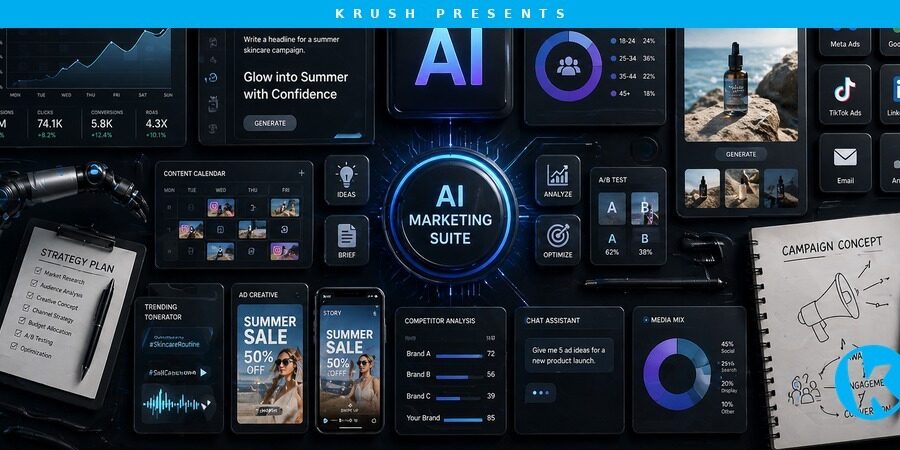
AI is everywhere in marketing now. It’s unavoidable and touches every stage of the marketing process. It’s writing first drafts of ad copy and social posts, generating images for campaigns, personalizing email marketing at scale, optimizing media buys in real time, analyzing customer data to identify audience segments, powering chatbots, predicting which leads are most likely to convert, and running A/B tests far faster than humans ever could.
It’s also doing a lot of behind-the-scenes work that people don’t see, such as SEO analysis, brand perception, and competitive monitoring. Your go-to marketing tools have rolled out “all new” AI enhancements in the reinvention race to stay relevant.
The Greatest Impact: Speed and Scale
The single biggest shift AI has brought to marketing is speed. Tasks that used to take a team days, like building out audience research, drafting multiple versions of campaign copy, or analyzing brand performance data, can now happen in hours, minutes or even seconds.
It’s not that the work is necessarily better yet, but there’s dramatically more of it happening faster. That compression of time frees up marketers to focus on strategy and the higher-order creative thinking that actually moves the needle. AI isn’t stealing creative time. It’s giving it back.
Where AI Shines and Where It Doesn’t
The tasks that benefit most from AI are the repetitive, data-heavy, or high-volume ones: email personalization, ad targeting and optimization, reporting and analytics, SEO keyword research, social media scheduling, and first-draft content generation. Essentially, anywhere there’s a pattern to recognize or a template to fill, AI excels.
Where it still struggles is nuance. Understanding a brand’s voice deeply, reading a room culturally, or making a bold creative leap that surprises people. That’s where human talent is irreplaceable. The key is knowing which tasks deserve that human talent and which ones don’t.
Will AI Take Over Marketing?
No, but it will reshape who thrives in it. Marketing and advertising won’t be taken over by AI.
They’ll be taken over by marketing professionals who know how to use AI. The skillset is shifting.
Think of it like when Photoshop came along. It didn’t replace designers, but designers who refused to learn it got left behind. The marketers who thrive will be the ones who can direct AI effectively, evaluate its output critically, and layer on the strategic and human insight that AI can’t replicate.
AI and Creativity: The Real Conversation
AI has leveled the playing field for creative production. A small business (agency or in-house) can now generate polished visuals and copy without a massive budget. It’s also a phenomenal brainstorming partner. It can generate dozens of concepts quickly, helping creative teams break out of ruts.
Yes, there’s a real risk of homogenization. If everyone is using the same tools with similar prompts, campaigns start looking and sounding the same. But the answer isn’t avoiding AI. It’s using it better. The best teams are using AI to handle the production layer while pushing their human creatives to go bolder and more original in the conceptual layer. AI raises the floor of creative output, but humans still have to raise the ceiling.
Does Using AI Hurt a Brand’s Image?
It depends entirely on how it’s used and how transparent the business is about it. Consumers generally don’t care how something was made if it resonates with them. But if AI-generated
content feels lazy, generic, or deceptive, that absolutely damages trust.
The businesses that use AI well are invisible about it. You don’t notice because the quality is high and the human oversight is strong.
The Ethics Question
AI in marketing raises several ethical concerns that the industry needs to take seriously.
Data privacy is the big one. AI-driven personalization relies on massive amounts of consumer data, and the line between helpful and invasive is thin. There’s also the issue of deepfakes and synthetic media being used in misleading ways, algorithmic bias that can inadvertently exclude or stereotype certain demographics, and transparency. Should brands disclose when content is AI-generated?
There’s also a labor question worth asking: as AI takes on more production work, what happens to the junior creatives and copywriters who used to build skills through that entry-level work?
The industry needs to think carefully about how it develops the next generation of talent.
These are legitimate concerns. But the answer is responsible adoption, not avoidance.
How AI Is Changing the Game for Small Business
Many small businesses are starting to rely on AI for marketing, and that’s actually one of AI’s biggest success stories. Businesses that couldn’t afford agencies are now using AI tools for social media content, email marketing, basic design work, and even ad management.
But “relying heavily” varies. Some are using it as a crutch without understanding fundamentals, while others are using it smartly to punch above their weight. The truth remains: if you don’t understand what good marketing looks like, AI won’t fix that for you. That’s where good strategy, whether from an internal team or an agency partner, still matters.
The Biggest Misconception
The biggest misconception about AI in marketing is that it replaces the need for strategy. People think they can tell AI to “make me a marketing campaign” and get something great. But AI is a tool, not a strategist. It doesn’t understand your brand’s positioning, your competitive landscape, or why your customers buy from you emotionally.
Without a human directing it with clear strategic intent, AI produces competent but forgettable work. The second misconception is that AI output is “done”.
It almost always needs human editing, judgment, and refinement.
The value of a great marketer or a great agency has never been in the production. It’s in the thinking. AI just makes that distinction clearer.
Looking Ahead
The future of marketing isn’t AI or humans. It’s AI amplifying the best human marketers.
We’re heading toward a model where AI handles the majority of production and optimization work, while human marketers focus on strategy, brand building, cultural insight, and the creative ideas that actually move people. The agencies and teams that will win are the ones that treat AI as infrastructure (reliable, fast, always running) and invest their human talent in the things AI genuinely can’t do: understanding people deeply, taking creative risks, and building brands that mean something.
The tools have changed. The job hasn’t. We’re still here to build brands, move people, and drive business. AI just helps us do it better.
The marketers who embrace that balance won’t just survive the AI era. They’ll define it.